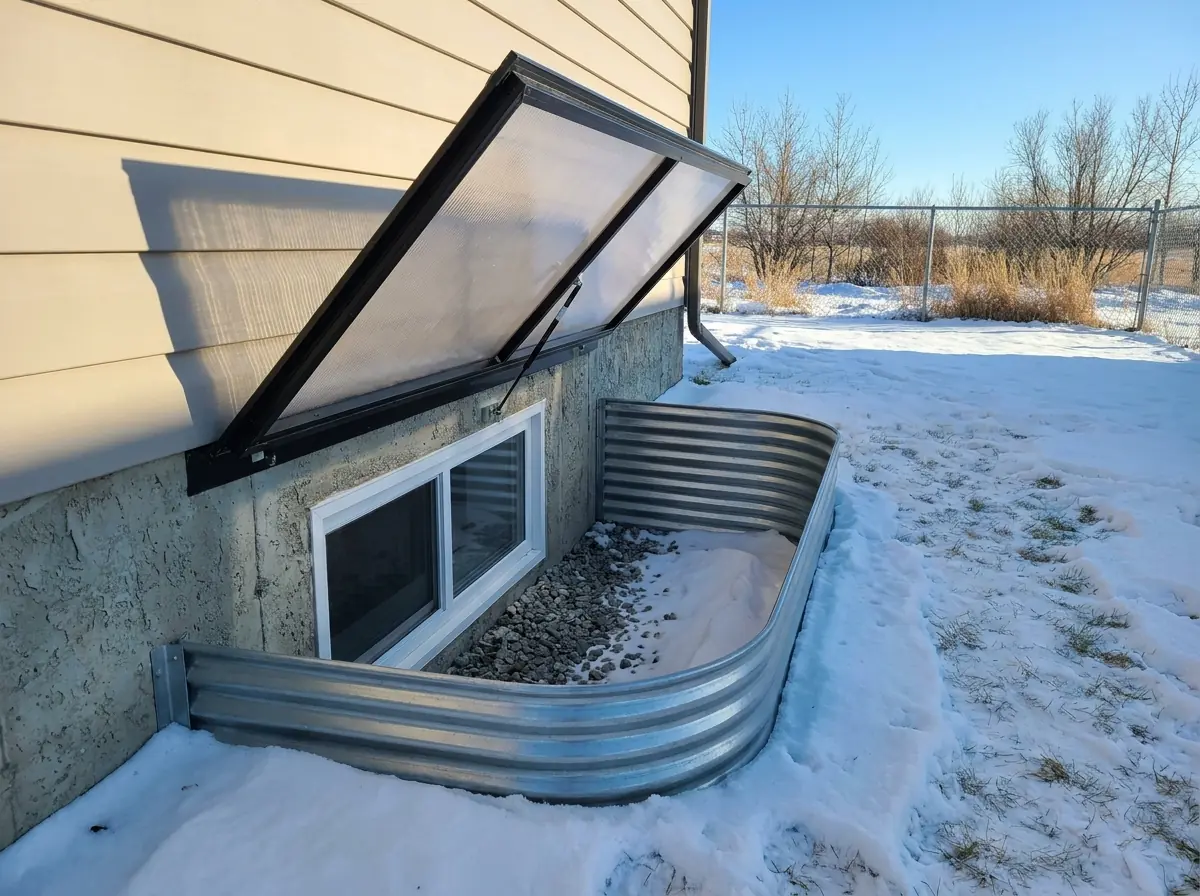
Window Well Covers and Code: Where a Cover Crosses the Line
A lot of homeowners believe the code bans window well covers. It is an easy conclusion to reach: the rules are about getting out, and putting a lid on the way out sounds like blocking it.
The real position is tighter and more practical. You can have a cover, provided it never gets in the way of what the well is there to do. Almost all of that comes down to reading one short phrase properly.
The wording everything hangs on
From inside the room, an egress window must open without tools and without special knowledge.
Apply that to the entire route out, not only the latch on the sash. A window that opens into a well nobody can climb out of is not an exit. Whoever uses it may be doing so at night, through smoke, perhaps a child, perhaps barely awake, and they need to be able to get all the way to the yard.
That phrase contains two tests. Covers usually get through the first and stumble on the second.
Without tools is the easy one to picture. No key, no screwdriver, no wrench. A cover secured with screws or bolts fails straight away, and nobody disputes it.
Without special knowledge is the one that gets overlooked. Escape cannot rely on knowing how something works. Think of a latch that only lets go in a set order, a panel that has to slide before it will lift, a catch on the outer side you have to feel for through a gap, or a lock whose key is kept upstairs. None of those needs a tool, and all of them fail, because you would only get them open if someone had shown you.
A good test to run at home: could an overnight guest, unfamiliar with your basement, get out in the dark without being told anything? If your honest reply is “after I showed them how”, the cover needs changing.
The good reasons to fit a cover
A cover has three genuine jobs, and each one is worthwhile.
Stopping falls. A deep well next to a path is easy to step into, and it catches cats, rabbits and now and then a small child.
Stopping debris. Leaves, lawn clippings and blown rubbish pile up in an open well and work their way into the drain, the single part of the well that must never plug. Why that matters more than expected in Calgary’s clay soil is covered in window well size and drainage.
Stopping snow. This one is local, and it makes the best case for a cover in this city.
Snow in Calgary window wells
Leave a well uncovered in Calgary and it fills with snow. It does not fill neatly; the well sits low in the wind, snow drifts into it, and the drift can pack hard.
Packed snow causes two problems. It blocks the way out during exactly the months when a way out is most likely to be needed, since the furnace and the fireplace run hardest in winter. And when a chinook blows through it melts, leaving water against the foundation and around the new window, which then refreezes overnight.
Shutting snow out of the well is a real benefit. A cover that carries a load of snow above the well raises a separate question, covered next.
Figures you will not find on this page
We do not publish a load a cover must support, in pounds, kilograms or anything else.
A well cover is a manufactured, engineered product, and its maker publishes its rating. That rating depends on the product, its span, how it is supported and how it was installed. When an installer’s blog prints a load number, the number has been made up, and on the question of whether the lid over your exit will stay up under snow, a made-up number can do real harm.
Go to the manufacturer, and read the installation instructions, not the sales sheet. If a quote includes a cover, ask for the product name and ask to see its documentation.
For the same reason we give no grate spacing, bar sizes or clearance tolerances. The only requirements we publish are the five egress figures Alberta’s building code sets.
How covers eat into well clearance
The well must keep 760 mm of clear projection, and a cover is not allowed to take any of it away.
That seems obvious until you look at how covers attach. A frame that sits down inside the well instead of resting on the rim, hinge hardware that pokes in, a support bar across the middle: each one removes some of the space the projection rule exists to protect.
In any well deeper than 1.2 m there is also a permanent ladder or steps, which likewise may not reduce that projection. Put a cover with an intruding frame onto a well that was already sized snugly around its ladder, and the clearance no longer adds up.
Get the order right. First size the well for the projection, allowing for the sash swing and the ladder. Then choose a cover that sits on top of everything. Doing it the other way round is where the trouble starts.
Choosing and checking a cover
Look for a cover that opens from underneath with one firm push: no latch, no fastener, no steps to remember. Check that nothing about it reaches down into the well. Confirm with the manufacturer what snow load it handles when installed the way yours will be. Then test it in February: go to the basement, open the window and push the cover up. That minute of effort is the only test worth trusting.
Unsure about a cover you already own? We check covers whenever we assess a well. That falls under wells and stairwells, and the suite compliance side is in the Calgary secondary suite egress rules.
If you would prefer someone else to make the judgement, send us the address.
Planning a basement window or door?
Tell us what the room or the entrance has to do, and we will come out and look at the wall itself. We work across Calgary, Airdrie, Cochrane and Okotoks.